Showing posts with label doodle. Show all posts

Sunday, September 27, 2020

Google turns 022 today and there is so much Google reaches legal drinking age: Happy Big 021 to Google - September 27, 1998

This is a reposting from an earlier post.  Some information may have been edited/added to original blog post. 


There was a great write up about Google celebrating itself with it's very own doodle ( a few years back) by Forbes Science and Technology contributor, Kiona Smith of Forbes titled Friday's Google Doodle Celebrates Google, But What Does That Mean? 


Below Google Doodle was from 2017:

From breathing out and breathing in to playing solitaire, Google celebrates 19th with 19 great games from doodles past! Happy birthday to Google :) may all your wishes come true :) Enjoy google's doodle by visiting 19th Google Birthday doodle or copy/paste this link https://www.google.com/search?q=google+birthday+surprise+spinner&oi=ddle&ct=googles-19th-birthday-us-6538650035683328&hl=en&source=doodle-ntp

Wednesday, October 30, 2019

Happy 124th Halloween - October 31, 1895

This post is an update from prior Halloween blog posts.
"Double, double toil and trouble;
fire burn and cauldron bubble."  


~~ William Shakespeare, “Macbeth, 1611 

English poet and playwright, widely regarded as the greatest writer in the English language and the world's pre-eminent dramatist. He is often called England's national poet and the "Bard of Avon". (1564-1616)


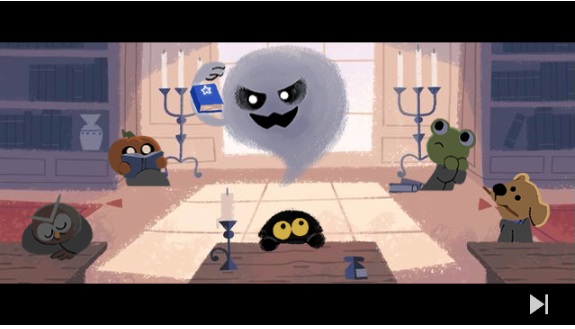
2018 Google Doodle celebrates Halloween a day earlier, with theme "The Great Ghoul Duels Catch the flames and when your opponent steals your flames, get them back and earn more points.


2017 Google Doodle celebrates Halloween with the Memo the Cat and her Magic Academy interactive contest doodle.

Follow feline freshman Momo on her quest to rescue her  magic academy. Score points and help ward off mischievious ghosts by swiping in the shape of the symbols above the ghosts’ heads. And you’d better pounce fast—the ghost that stole the master spellbook is getting away! 


HAPPY HALLOWEEN DOODLE and BoooOooH ha ha ha to all ghastly ghosts & evil spirits!


Save Momo's Music Academy and earn game points by swiping the shape on top of the ghosts' heads and wipe out all the ghosts.

I scored 1660! 


How many ghosts can you wipe out?


Much more than a just a Google doodle, today many internet surfers enjoyed spooky, interactive, search results instead of Google’s customary and “I’m Feeling Lucky” search options.

Eighteen Halloween's ago, Google posted it's very first Halloween Google Doodle.

Photo right, screen capture of Google's first Halloween Doodle, October 31, 1999.

Internationally, Halloween's first celebration traces back to 1895 in Scotland and for North America the first Halloween was celebrated in 1911.


Enjoy this collage of Halloween Google Doodles above or to experience Google Doodles of Halloween's past, visit the following links:
Halloween 2017 Google Doodle: Jinx's Night Out 
Halloween Momo on Her Mission 2016
Halloween Global Candy Cup 2015
Favorite Monsters Google Doodle 2014
Google Halloween 2013 doodle.
Google Halloween 2012 doodle
Google's 2011 carving pumpkin doodle celebrating 100 Halloween years
Google Halloween 2010 doodle
Google Halloween 2009 doodle
Google Halloween 2008 doodle
Google Halloween 2007 doodle
Google Halloween 2006 doodle
Google Halloween 2005 doodle
Google Halloween 2004 doodle
Google Halloween 2003 doodle
Google Halloween 2002 doodle
Google Halloween 2001 doodle
Google Halloween 2000 doodle
Google Halloween 1999 doodle

Happy Halloween to you and yours!


What do you think of Google’s Halloween doodle today?

ABOUT HALLOWEEN AND HISTORY

Halloween or Hallowe'en (a contraction of "All Hallows' Evening"), also known as All Hallows' Eve, is a yearly celebration observed in a number of countries on October 31, the eve of the Western Christian feast of All Hallows (or All Saints) and the day initiating the triduum of Hallowmas.

Trick-or-treating is a customary celebration for children on Halloween. Children go in costume from house to house, asking for treats such as candy or sometimes money, with the question, "Trick or treat?" The word "trick" refers to "threat" to perform mischief on the homeowners or their property if no treat is given.

According to Frank Leslie's popular monthly, (Volume 40, November 1895, p. 540-543) in Scotland and Ireland, guising – children disguised in costume going from door to door for food or coins – is a traditional Halloween custom, and was recorded in Scotland at Halloween as far back as 1895 where masqueraders in disguise carrying lanterns made out of scooped out turnips, visited homes to be rewarded with cakes, fruit and money.

The practice of Guising at Halloween in North America was first recorded in 1911, where a newspaper in Kingston, Ontario reported children going "guising" around the neighborhood was first noted by Rogers, Nicholas, "Coming Over: Halloween in North America". Halloween: From Pagan Ritual to Party Night. p.76. Oxford University Press, 2002, ISBN 0-19-514691-3.

American historian and author Ruth Edna Kelley of Massachusetts wrote the first book length history of Halloween in the US; The Book of Hallowe'en (1919), and references souling in the chapter "Hallowe'en in America":

"The taste in Hallowe'en festivities now is to study old traditions, and hold a Scotch party, using Burn's poem Hallowe'en as a guide; or to go a-souling as the English used. In short, no custom that was once honored at Hallowe'en is out of fashion now."

OTHER RESOURCES 

▲ Google's Halloween doodle turns you into a witch, CNET, http://news.cnet.com/8301-1023_3-57610125-93/googles-halloween-doodle-turns-you-into-a-witch/
▲ The wizards behind Google's doodles, CNET, http://news.cnet.com/8301-1023_3-57573307-93/the-wizards-behind-googles-doodles/
▲ Halloween witch: The real history behind Google's doodle, The Christian Monitor, http://www.csmonitor.com/Innovation/2013/1031/Halloween-witch-The-real-history-behind-Google-s-doodle 


Please share this on your LinkedIn, Facebook, Twitter, and other social media networks you enjoy! Thanks! This is a reposting from previous Happy Halloween blog postings from AllThingsDigitalMarketing.


This post is an update from prior Halloween blog posts.

Thursday, September 26, 2019

Google reaches legal drinking age: HahahaHappy Big 021 to Google - September 27, 2019

This is a reposting from an earlier post.  Some information may have been edited/added to original blog post.

Will share if there is a Google doodle celebrating their 21st.

Yes there is a great write up about Google celebrating itself with it's very own doodle by Forbes Science and Technology contributor, Kiona Smith of Forbes titled Friday's Google Doodle Celebrates Google, But What Does That Mean?


Below Google Doodle was from 2017:

From breathing out and breathing in to playing solitaire, Google celebrates 19th with 19 great games from doodles past! Happy birthday to Google :) may all your wishes come true :) Enjoy google's doodle by visiting 19th Google Birthday doodle or copy/paste this link https://www.google.com/search?q=google+birthday+surprise+spinner&oi=ddle&ct=googles-19th-birthday-us-6538650035683328&hl=en&source=doodle-ntp

Tuesday, October 30, 2018

Happy 123rd Halloween - October 31, 1895


This post is an update from prior Halloween blog posts.

"Double, double toil and trouble;
fire burn and cauldron bubble."  


~~ William Shakespeare, “Macbeth, 1611 

English poet and playwright, widely regarded as the greatest writer in the English language and the world's pre-eminent dramatist. He is often called England's national poet and the "Bard of Avon". (1564-1616)


2018 Google Doodle celebrates Halloween a day earlier, with theme "The Great Ghoul Duels Catch the flames and when your opponent steals your flames, get them back and earn more points.


2017 Google Doodle celebrates Halloween with the Memo the Cat and her Magic Academy interactive contest doodle.

Follow feline freshman Momo on her quest to rescue her  magic academy. Score points and help ward off mischievious ghosts by swiping in the shape of the symbols above the ghosts’ heads. And you’d better pounce fast—the ghost that stole the master spellbook is getting away! 


HAPPY HALLOWEEN DOODLE and BoooOooH ha ha ha to all ghastly ghosts & evil spirits!


Save Momo's Music Academy and earn game points by swiping the shape on top of the ghosts' heads and wipe out all the ghosts.  

I scored 1660! 


How many ghosts can you wipe out?


Much more than a just a Google doodle, today many internet surfers enjoyed spooky, interactive, search results instead of Google’s customary and “I’m Feeling Lucky” search options.

Eighteen Halloween's ago, Google posted it's very first Halloween Google Doodle.

Photo right, screen capture of Google's first Halloween Doodle, October 31, 1999.

Internationally, Halloween's first celebration traces back to 1895 in Scotland and for North America the first Halloween was celebrated in 1911.


Enjoy this collage of Halloween Google Doodles above or to experience Google Doodles of Halloween's past, visit the following links:
Halloween 2017 Google Doodle: Jinx's Night Out 
Halloween Momo on Her Mission 2016
Halloween Global Candy Cup 2015
Favorite Monsters Google Doodle 2014
Google Halloween 2013 doodle.
Google Halloween 2012 doodle
Google's 2011 carving pumpkin doodle celebrating 100 Halloween years
Google Halloween 2010 doodle
Google Halloween 2009 doodle
Google Halloween 2008 doodle
Google Halloween 2007 doodle
Google Halloween 2006 doodle
Google Halloween 2005 doodle
Google Halloween 2004 doodle
Google Halloween 2003 doodle
Google Halloween 2002 doodle
Google Halloween 2001 doodle
Google Halloween 2000 doodle
Google Halloween 1999 doodle

Happy Halloween to you and yours!


What do you think of Google’s Halloween doodle today?

ABOUT HALLOWEEN AND HISTORY

Halloween or Hallowe'en (a contraction of "All Hallows' Evening"), also known as All Hallows' Eve, is a yearly celebration observed in a number of countries on October 31, the eve of the Western Christian feast of All Hallows (or All Saints) and the day initiating the triduum of Hallowmas.

Trick-or-treating is a customary celebration for children on Halloween. Children go in costume from house to house, asking for treats such as candy or sometimes money, with the question, "Trick or treat?" The word "trick" refers to "threat" to perform mischief on the homeowners or their property if no treat is given.

According to Frank Leslie's popular monthly, (Volume 40, November 1895, p. 540-543) in Scotland and Ireland, guising – children disguised in costume going from door to door for food or coins – is a traditional Halloween custom, and was recorded in Scotland at Halloween as far back as 1895 where masqueraders in disguise carrying lanterns made out of scooped out turnips, visited homes to be rewarded with cakes, fruit and money.

The practice of Guising at Halloween in North America was first recorded in 1911, where a newspaper in Kingston, Ontario reported children going "guising" around the neighborhood was first noted by Rogers, Nicholas, "Coming Over: Halloween in North America". Halloween: From Pagan Ritual to Party Night. p.76. Oxford University Press, 2002, ISBN 0-19-514691-3.

American historian and author Ruth Edna Kelley of Massachusetts wrote the first book length history of Halloween in the US; The Book of Hallowe'en (1919), and references souling in the chapter "Hallowe'en in America":

"The taste in Hallowe'en festivities now is to study old traditions, and hold a Scotch party, using Burn's poem Hallowe'en as a guide; or to go a-souling as the English used. In short, no custom that was once honored at Hallowe'en is out of fashion now."

OTHER RESOURCES 

▲ Google's Halloween doodle turns you into a witch, CNET, http://news.cnet.com/8301-1023_3-57610125-93/googles-halloween-doodle-turns-you-into-a-witch/
▲ The wizards behind Google's doodles, CNET, http://news.cnet.com/8301-1023_3-57573307-93/the-wizards-behind-googles-doodles/
▲ Halloween witch: The real history behind Google's doodle, The Christian Monitor, http://www.csmonitor.com/Innovation/2013/1031/Halloween-witch-The-real-history-behind-Google-s-doodle 


Please share this on your LinkedIn, Facebook, Twitter, and other social media networks you enjoy! Thanks! This is a reposting from previous Happy Halloween blog postings from AllThingsDigitalMarketing.


This post is an update from prior Halloween blog posts.

Tuesday, October 31, 2017

Happy 122nd Halloween - October 31, 1895


"Double, double toil and trouble;
fire burn and cauldron bubble."  


~~ William Shakespeare, “Macbeth, 1611 

English poet and playwright, widely regarded as the greatest writer in the English language and the world's pre-eminent dramatist. He is often called England's national poet and the "Bard of Avon". (1564-1616)


Google Doodle celebrates Halloween with the Memo the Cat and her Magic Academy interactive contest doodle.

Follow feline freshman Momo on her quest to rescue her  magic academy. Score points and help ward off mischievious ghosts by swiping in the shape of the symbols above the ghosts’ heads. And you’d better pounce fast—the ghost that stole the master spellbook is getting away! 


HAPPY HALLOWEEN DOODLE and BoooOooH ha ha ha to all ghastly ghosts & evil spirits!


Save Momo's Music Academy and earn game points by swiping the shape on top of the ghosts' heads and wipe out all the ghosts.  

I scored 1660! 


How many ghosts can you wipe out?


Much more than a just a Google doodle, today many internet surfers enjoyed spooky, interactive, search results instead of Google’s customary and “I’m Feeling Lucky” search options.

Eighteen Halloween's ago, Google posted it's very first Halloween Google Doodle.

Photo right, screen capture of Google's first Halloween Doodle, October 31, 1999.

Internationally, Halloween's first celebration traces back to 1895 in Scotland and for North America the first Halloween was celebrated in 1911.


Enjoy this collage of Halloween Google Doodles above or to experience Google Doodles of Halloween's past, visit the following links:

Halloween Momo on Her Mission 2016
Halloween Global Candy Cup 2015
Favorite Monsters Google Doodle 2014
Google Halloween 2013 doodle.
Google Halloween 2012 doodle
Google's 2011 carving pumpkin doodle celebrating 100 Halloween years
Google Halloween 2010 doodle
Google Halloween 2009 doodle
Google Halloween 2008 doodle
Google Halloween 2007 doodle
Google Halloween 2006 doodle
Google Halloween 2005 doodle
Google Halloween 2004 doodle
Google Halloween 2003 doodle
Google Halloween 2002 doodle
Google Halloween 2001 doodle
Google Halloween 2000 doodle
Google Halloween 1999 doodle

Happy Halloween to you and yours!


What do you think of Google’s Halloween doodle today?

ABOUT HALLOWEEN AND HISTORY

Halloween or Hallowe'en (a contraction of "All Hallows' Evening"), also known as All Hallows' Eve, is a yearly celebration observed in a number of countries on October 31, the eve of the Western Christian feast of All Hallows (or All Saints) and the day initiating the triduum of Hallowmas.

Trick-or-treating is a customary celebration for children on Halloween. Children go in costume from house to house, asking for treats such as candy or sometimes money, with the question, "Trick or treat?" The word "trick" refers to "threat" to perform mischief on the homeowners or their property if no treat is given.

According to Frank Leslie's popular monthly, (Volume 40, November 1895, p. 540-543) in Scotland and Ireland, guising – children disguised in costume going from door to door for food or coins – is a traditional Halloween custom, and was recorded in Scotland at Halloween as far back as 1895 where masqueraders in disguise carrying lanterns made out of scooped out turnips, visited homes to be rewarded with cakes, fruit and money.

The practice of Guising at Halloween in North America was first recorded in 1911, where a newspaper in Kingston, Ontario reported children going "guising" around the neighborhood was first noted by Rogers, Nicholas, "Coming Over: Halloween in North America". Halloween: From Pagan Ritual to Party Night. p.76. Oxford University Press, 2002, ISBN 0-19-514691-3.

American historian and author Ruth Edna Kelley of Massachusetts wrote the first book length history of Halloween in the US; The Book of Hallowe'en (1919), and references souling in the chapter "Hallowe'en in America":

"The taste in Hallowe'en festivities now is to study old traditions, and hold a Scotch party, using Burn's poem Hallowe'en as a guide; or to go a-souling as the English used. In short, no custom that was once honored at Hallowe'en is out of fashion now."

OTHER RESOURCES 

▲ Google's Halloween doodle turns you into a witch, CNET, http://news.cnet.com/8301-1023_3-57610125-93/googles-halloween-doodle-turns-you-into-a-witch/
▲ The wizards behind Google's doodles, CNET, http://news.cnet.com/8301-1023_3-57573307-93/the-wizards-behind-googles-doodles/
▲ Halloween witch: The real history behind Google's doodle, The Christian Monitor, http://www.csmonitor.com/Innovation/2013/1031/Halloween-witch-The-real-history-behind-Google-s-doodle 


Please share this on your LinkedIn, Facebook, Twitter, and other social media networks you enjoy! Thanks! This is a reposting from previous Happy Halloween blog postings from AllThingsDigitalMarketing.

Wednesday, September 27, 2017

Happy 19th birthday Google - September 27, 2017

From breathing out and breathing in to playing solitaire, Google celebrates 19th with 19 great games from doodles past! Happy birthday to Google :) may all your wishes come true :) Enjoy google's doodle by visiting 19th Google Birthday doodle or copy/paste this link https://www.google.com/search?q=google+birthday+surprise+spinner&oi=ddle&ct=googles-19th-birthday-us-6538650035683328&hl=en&source=doodle-ntp

Monday, October 31, 2016

Happy 105th Halloween - October 31, 1895


"Double, double toil and trouble;
fire burn and cauldron bubble."  


~~ William Shakespeare, “Macbeth, 1611 

English poet and playwright, widely regarded as the greatest writer in the English language and the world's pre-eminent dramatist. He is often called England's national poet and the "Bard of Avon". (1564-1616)


Google Doodle celebrates Halloween with the Memo the Cat and her Magic Academy interactive contest doodle.

Follow feline freshman Momo on her quest to rescue her  magic academy. Score points and help ward off mischievious ghosts by swiping in the shape of the symbols above the ghosts’ heads. And you’d better pounce fast—the ghost that stole the master spellbook is getting away! 


HAPPY HALLOWEEN DOODLE and BoooOooH ha ha ha to all ghastly ghosts & evil spirits!


Save Momo's Music Academy and earn game points by swiping the shape on top of the ghosts' heads and wipe out all the ghosts.  

I scored 1660! 


How many ghosts can you wipe out?


Much more than a just a Google doodle, today many internet surfers enjoyed spooky, interactive, search results instead of Google’s customary and “I’m Feeling Lucky” search options.

Eighteen Halloween's ago, Google posted it's very first Halloween Google Doodle.

Photo right, screen capture of Google's first Halloween Doodle, October 31, 1999.

Internationally, Halloween's first celebration traces back to 1895 in Scotland and for North America the first Halloween was celebrated in 1911.


Enjoy this collage of Halloween Google Doodles above or to experience Google Doodles of Halloween's past, visit the following links:

Halloween Momo on Her Mission 2016
Halloween Global Candy Cup 2015
Favorite Monsters Google Doodle 2014
Google Halloween 2013 doodle.
Google Halloween 2012 doodle
Google's 2011 carving pumpkin doodle celebrating 100 Halloween years
Google Halloween 2010 doodle
Google Halloween 2009 doodle
Google Halloween 2008 doodle
Google Halloween 2007 doodle
Google Halloween 2006 doodle
Google Halloween 2005 doodle
Google Halloween 2004 doodle
Google Halloween 2003 doodle
Google Halloween 2002 doodle
Google Halloween 2001 doodle
Google Halloween 2000 doodle
Google Halloween 1999 doodle

Happy Halloween to you and yours!


What do you think of Google’s Halloween doodle today?

ABOUT HALLOWEEN AND HISTORY

Halloween or Hallowe'en (a contraction of "All Hallows' Evening"), also known as All Hallows' Eve, is a yearly celebration observed in a number of countries on October 31, the eve of the Western Christian feast of All Hallows (or All Saints) and the day initiating the triduum of Hallowmas.

Trick-or-treating is a customary celebration for children on Halloween. Children go in costume from house to house, asking for treats such as candy or sometimes money, with the question, "Trick or treat?" The word "trick" refers to "threat" to perform mischief on the homeowners or their property if no treat is given.

According to Frank Leslie's popular monthly, (Volume 40, November 1895, p. 540-543) in Scotland and Ireland, guising – children disguised in costume going from door to door for food or coins – is a traditional Halloween custom, and was recorded in Scotland at Halloween as far back as 1895 where masqueraders in disguise carrying lanterns made out of scooped out turnips, visited homes to be rewarded with cakes, fruit and money.

The practice of Guising at Halloween in North America was first recorded in 1911, where a newspaper in Kingston, Ontario reported children going "guising" around the neighborhood was first noted by Rogers, Nicholas, "Coming Over: Halloween in North America". Halloween: From Pagan Ritual to Party Night. p.76. Oxford University Press, 2002, ISBN 0-19-514691-3.

American historian and author Ruth Edna Kelley of Massachusetts wrote the first book length history of Halloween in the US; The Book of Hallowe'en (1919), and references souling in the chapter "Hallowe'en in America":

"The taste in Hallowe'en festivities now is to study old traditions, and hold a Scotch party, using Burn's poem Hallowe'en as a guide; or to go a-souling as the English used. In short, no custom that was once honored at Hallowe'en is out of fashion now."

OTHER RESOURCES 

▲ Google's Halloween doodle turns you into a witch, CNET, http://news.cnet.com/8301-1023_3-57610125-93/googles-halloween-doodle-turns-you-into-a-witch/
▲ The wizards behind Google's doodles, CNET, http://news.cnet.com/8301-1023_3-57573307-93/the-wizards-behind-googles-doodles/
▲ Halloween witch: The real history behind Google's doodle, The Christian Monitor, http://www.csmonitor.com/Innovation/2013/1031/Halloween-witch-The-real-history-behind-Google-s-doodle 
Please share this on your LinkedIn, Facebook, Twitter, and other social media networks you enjoy! Thanks!

Thursday, December 10, 2015

Happy 200th B-Day to world’s first known computer programmer, Ada Lovelace (b. December 10, 1815) ▲ ▲ ▲
'evergreen marketing insighter' by Gloria Buono-Daly

The analytical engine weaves algebraic equations just as the Jacquard loom weaves flowers and leaves.”
~~ Ada Lovelace

from notes on Menabrae’s Memoir on the Analytic Engine, 1843

Did you know that the world's first known computer programmer and the founder of computer science was a woman?

IT LEADERSHIP GAP IN POSITIONS FOR WOMEN

In memory of Ada Lovelace, let's celebrate women in math and science. To think even with all the progress women have made and in our world of digital, it's so hard to imagine the first geek was a female, way back in the mid 1800s yet men represent 91% of senior IT management positions.

According to Judith Warner, Senior Fellow at Center for American Progress women hold only 9 percent of IT management positions and account for only 14 percent of senior management positions at Silicon Valley startups (as of March 2014).

According to a CNN analysis, "Still Missing: Female Business Leaders," (3/2015) "Only 14.2% of the top five leadership positions at the companies in the S&P 500 are held by women..."


MORE ABOUT ADA LOVELACE
A Big Happy 200th B-Day to Ada Lovelace (10 December 1815 – 27 November 1852). Ada was an English mathematician and writer chiefly known for her work on Charles Babbage's early mechanical general-purpose computer, the analytical engine. Her notes on the engine include what is recognized as the first algorithm intended to be processed by a machine; thanks to this, she is sometimes considered the world's first computer programmer, founder and prophet of scientific computing and enchantress of numbers.


ADA LOVELACE EXCERPTS FROM WIKIPEDIA
As a young adult, she took an interest in mathematics, and in particular Babbage's work on the analytical engine. Between 1842 and 1843, she translated an article by Italian mathematician Luigi Menabrea on the engine, which she supplemented with a set of notes of her own. These notes contain what is considered the first computer program — that is, an algorithm encoded for processing by a machine.

Born Augusta “Ada” Byron on December 10, 1815 to poet George Gordon Byron, 6th Baron Byron, and his wife, Anne Isabella "Annabella" Milbanke, Baroness Byron. Byron, and many of those who knew Byron, expected that the baby would be "the glorious boy", and there was some disappointment at the contrary news. As a child, Ada was often ill and when she was eight, she experienced headaches that obscured her vision. She became paralysed in June 1829, from the measles. She was subjected to continuous bed rest and by 1831 she was able to walk with crutches.
At the age of 17 her remarkable mathematical abilities began to emerge, and her interest in mathematics dominated the majority of her adult life.


In a letter to Lady Byron, De Morgan suggested that her daughter's skill in mathematics could lead her to become "an original mathematical investigator, perhaps of first-rate eminence.

On 8 July 1835 she married William King, 8th Baron King, becoming Baroness King. They had three children; Byron born 12 May 1836, Anne Isabella (called Annabella, later Lady Anne Blunt) born 22 September 1837 and Ralph Gordon born 2 July 1839. Immediately after the birth of Annabella, Lady King experienced "a tedious and suffering illness, which took months to cure". In 1838, her husband was created Earl of Lovelace. Thus, she was styled "The Right Honorable the Countess of Lovelace" for most of her married life.

The computer language Ada, created on behalf of the United States Department of Defense, was named after Ada Lovelace. The reference manual for the language was approved on 10 December 1980, and the Department of Defense Military Standard for the language, "MIL-STD-1815", was given the number of the year of her birth. Since 1998, the British Computer Society has awarded a medal in her name and in 2008 initiated an annual competition for women students of computer science.


All photos courtesy of Wikimedia unless otherwise indicated.


Additional resources:
Women's Leadership Gap (PDF Report as of March 7, 2014), Center for American Progress
Google Doodle celebrates Ada Lovelace Washington Post
The Babbage Engine, Computer History
Ada Lovelace, World's First Computer Programmer, Celebrated With Google Doodle, Huffington Post
Ada Byron, Countess of Lovelace, SDSC


Please visit this blog frequently and share this with your social media. Thanks.

Saturday, October 31, 2015

Happy 104th Halloween America ▲ Pick a Witch with Google's Doodle


"Double, double toil and trouble;
fire burn and cauldron bubble."

~~ William Shakespeare, “Macbeth, 1611

English poet and playwright, widely regarded as the greatest writer in the English language and the world's pre-eminent dramatist. He is often called England's national poet and the "Bard of Avon". (1564-1616)


Google Doodle celebrates Halloween with the Global Candy Cup 2015 interactive contest doodle.

Red witch, green witch, yellow witch, blue witch ~ Are you a blue, red, yellow or green witch? Pick a Witch with Google's Halloween Candy Cup Contest doodle and BoooOooH ha ha ha to witches and broomsticks :)

The "Choose a team and grab that candy" Google Doodle is a global interactive competition of four witches who race to collect the most candy before the end of Halloween. Pick a witch and keep playing throughout the day to add to your team’s score. Only one team will go home with the Cup — will it be yours?

You can concoct your own witches brew potion with this innovative witches brew interactive doodle.

Using combinations of apple, bone, skull or tonic by clicking on the icon will stir up different witch brews.

Are you a kind sparkling, good witch or a mean green, bad witch?

Much more than a just a Google doodle, today many internet surfers enjoyed spooky, interactive, search results instead of Google’s customary and “I’m Feeling Lucky” search options.

Fifteen Halloween's ago, Google posted it's very first Halloween Google Doodle.

Photo right, screen capture of Google's first Halloween Doodle, October 31, 1999.

Internationally, Halloween's first celebration traces back to 1895 in Scotland and for North America the first Halloween was celebrated in 1911.


Enjoy this collage of Halloween Google Doodles above or to experience Google Doodles of Halloween's past, visit the following links:

Halloween Global Candy Cup 2015
Favorite Monsters Google Doodle 2014
Google Halloween 2013 doodle.
Google Halloween 2012 doodle
Google's 2011 carving pumpkin doodle celebrating 100 Halloween years
Google Halloween 2010 doodle
Google Halloween 2009 doodle
Google Halloween 2008 doodle
Google Halloween 2007 doodle
Google Halloween 2006 doodle
Google Halloween 2005 doodle
Google Halloween 2004 doodle
Google Halloween 2003 doodle
Google Halloween 2002 doodle
Google Halloween 2001 doodle
Google Halloween 2000 doodle
Google Halloween 1999 doodle

Happy Halloween to you and yours!


What do you think of Google’s Halloween doodle today?

ABOUT HALLOWEEN AND HISTORY

Halloween or Hallowe'en (a contraction of "All Hallows' Evening"), also known as All Hallows' Eve, is a yearly celebration observed in a number of countries on October 31, the eve of the Western Christian feast of All Hallows (or All Saints) and the day initiating the triduum of Hallowmas.

Trick-or-treating is a customary celebration for children on Halloween. Children go in costume from house to house, asking for treats such as candy or sometimes money, with the question, "Trick or treat?" The word "trick" refers to "threat" to perform mischief on the homeowners or their property if no treat is given.

According to Frank Leslie's popular monthly, (Volume 40, November 1895, p. 540-543) in Scotland and Ireland, guising – children disguised in costume going from door to door for food or coins – is a traditional Halloween custom, and was recorded in Scotland at Halloween as far back as 1895 where masqueraders in disguise carrying lanterns made out of scooped out turnips, visited homes to be rewarded with cakes, fruit and money.

The practice of Guising at Halloween in North America was first recorded in 1911, where a newspaper in Kingston, Ontario reported children going "guising" around the neighborhood was first noted by Rogers, Nicholas, "Coming Over: Halloween in North America". Halloween: From Pagan Ritual to Party Night. p.76. Oxford University Press, 2002, ISBN 0-19-514691-3.

American historian and author Ruth Edna Kelley of Massachusetts wrote the first book length history of Halloween in the US; The Book of Hallowe'en (1919), and references souling in the chapter "Hallowe'en in America":

"The taste in Hallowe'en festivities now is to study old traditions, and hold a Scotch party, using Burn's poem Hallowe'en as a guide; or to go a-souling as the English used. In short, no custom that was once honored at Hallowe'en is out of fashion now."

OTHER RESOURCES

▲ Google's Halloween doodle turns you into a witch, CNET, http://news.cnet.com/8301-1023_3-57610125-93/googles-halloween-doodle-turns-you-into-a-witch/
▲ The wizards behind Google's doodles, CNET, http://news.cnet.com/8301-1023_3-57573307-93/the-wizards-behind-googles-doodles/
▲ Halloween witch: The real history behind Google's doodle, The Christian Monitor, http://www.csmonitor.com/Innovation/2013/1031/Halloween-witch-The-real-history-behind-Google-s-doodle
Please share this on your LinkedIn, Facebook, Twitter, and other social media networks you enjoy! Thanks!

Tuesday, December 9, 2014

Happy 199th B-Day to world’s first known computer programmer, Ada Lovelace (b. December 10, 1815) ▲ ▲ ▲
'evergreen marketing insighter' by Gloria Buono-Daly

The analytical engine weaves algebraic equations just as the Jacquard loom weaves flowers and leaves.”
~~ Ada Lovelace

from notes on Menabrae’s Memoir on the Analytic Engine, 1843

Did you know that the world's first known computer programmer and the founder of computer science was a woman?

IT LEADERSHIP GAP IN POSITIONS FOR WOMEN

In memory of Ada Lovelace, let's celebrate women in math and science. To think even with all the progress women have made and in our world of digital, it's so hard to imagine the first geek was a female, way back in the mid 1800s yet men represent 91% of senior IT management positions.

According to Judith Warner, Senior Fellow at Center for American Progress women hold only 9 percent of IT management positions and account for only 14 percent of senior management positions at Silicon Valley startups (as of March 2014).


MORE ABOUT ADA LOVELACE
Happy 199th B-Day to Ada Lovelace (10 December 1815 – 27 November 1852). Ada was an English mathematician and writer chiefly known for her work on Charles Babbage's early mechanical general-purpose computer, the analytical engine. Her notes on the engine include what is recognized as the first algorithm intended to be processed by a machine; thanks to this, she is sometimes considered the world's first computer programmer, founder and prophet of scientific computing and enchantress of numbers.


ADA LOVELACE EXCERPTS FROM WIKIPEDIA
As a young adult, she took an interest in mathematics, and in particular Babbage's work on the analytical engine. Between 1842 and 1843, she translated an article by Italian mathematician Luigi Menabrea on the engine, which she supplemented with a set of notes of her own. These notes contain what is considered the first computer program — that is, an algorithm encoded for processing by a machine.

Born Augusta “Ada” Byron on December 10, 1815 to poet George Gordon Byron, 6th Baron Byron, and his wife, Anne Isabella "Annabella" Milbanke, Baroness Byron. Byron, and many of those who knew Byron, expected that the baby would be "the glorious boy", and there was some disappointment at the contrary news. As a child, Ada was often ill and when she was eight, she experienced headaches that obscured her vision. She became paralysed in n June 1829, from the measles. She was subjected to continuous bed rest and by 1831 she was able to walk with crutches.
At the age of 17 her remarkable mathematical abilities began to emerge, and her interest in mathematics dominated the majority of her adult life.


In a letter to Lady Byron, De Morgan suggested that her daughter's skill in mathematics could lead her to become "an original mathematical investigator, perhaps of first-rate eminence.

On 8 July 1835 she married William King, 8th Baron King, becoming Baroness King. They had three children; Byron born 12 May 1836, Anne Isabella (called Annabella, later Lady Anne Blunt) born 22 September 1837 and Ralph Gordon born 2 July 1839. Immediately after the birth of Annabella, Lady King experienced "a tedious and suffering illness, which took months to cure". In 1838, her husband was created Earl of Lovelace. Thus, she was styled "The Right Honorable the Countess of Lovelace" for most of her married life.

The computer language Ada, created on behalf of the United States Department of Defense, was named after Ada Lovelace. The reference manual for the language was approved on 10 December 1980, and the Department of Defense Military Standard for the language, "MIL-STD-1815", was given the number of the year of her birth. Since 1998, the British Computer Society has awarded a medal in her name and in 2008 initiated an annual competition for women students of computer science.


All photos courtesy of Wikimedia unless otherwise indicated.


Additional resources:
Women's Leadership Gap (PDF Report as of March 7, 2014), Center for American Progress
Google Doodle celebrates Ada Lovelace Washington Post
The Babbage Engine, Computer History
Ada Lovelace, World's First Computer Programmer, Celebrated With Google Doodle, Huffington Post
Ada Byron, Countess of Lovelace, SDSC


Please visit this blog frequently and share this with your social media. Thanks.