Showing posts with label internet. Show all posts

Sunday, July 11, 2021

Nine years ago today ~ Marketing and the importance of purpose: First of a series of “evergreen marketing insights” by Gloria Buono-Daly

This is a reposting with a few edits. The first of a series of evergreen marketing insights initially posted on Examiner 9 years ago - July 12, 2012!


Do you have your purpose statement or personal brand statement?  Well, you should! Here's mine:

"I'm just an "unthinkable resilientist" simplifying the complex and obstructing the negative. 

Now it's your turn to tell me yours. You never know, you may end up inventing a new word organically, just like I did.


Purpose, it’s important, we all have it and use it in our everyday lives. Yet whenever one is asked to define his/her purpose, why is it so difficult to answer?  What are your apprehensions? 


The rust on the fence symbolizes aging, no longer resilient yet still cool and beautiful. The fence atop the railroad, a reminder sometimes we need to stop to enjoy the beauty, be cautious and stay on track. 

Photo credit: Gloria Buono-Daly, taken in NYC, Spring 2011

There are so many books/blog posts/articles, etc., both digitally and in print about personal branding and the importance of knowing your purpose. 

Photo credit: Gloria Buono-Daly, taken in NYC March 2012.


 One of the many things we don’t learn in school or on the job is the importance of personal brand.

How else can you create an innovative marketing plan and understand the purpose of your plan without initially understanding the real meaning of why you are here?

Marketing, like purpose, is having a clear perspective, confidence and drive, ultimately bringing substantial contributions and value in everything you do.
Just as no two fingerprints are alike, no two marketers are alike - we all have a special and unique story that is incorporated into our work whether we are aware of it or not. 


 There may be similar skill-sets, education, or a generic marketing plan/guideline, but it is the unique initiative, thinking, and creative execution in our work that motivates us to act and accomplish.

When tackling the question “what is your purpose?” one may perceive it as networking all the time or being on the Internet all day writing, but to say this would be deceiving. Gravitating towards networking in person or on the Internet, illustrates the enjoyment and appreciation of meeting and learning about others, e.g., marketers, writers, etc.

This also illustrates interest and enthusiasm to participate interactively by sharing comments, suggestions, and ideas. This can be mentally stimulating (like reading a good book or tablet). If this action touched one person or encouraged many to think, imagine, and improve, then this has made a difference and helped someone.

There are many reasons why purpose is a major element for marketers and personal brand. Think about it and share your thoughts, which will be incorporated into the next series article titled, "Marketing and the importance of being personal."


One of my favorite inspiring quotes to help you find and define your purpose:  

"Out of clutter, find simplicity. From discord, find harmony. In the middle of difficulty lies opportunity."   ~ Albert Einstein, German theoretical physicist, world renown as the father of Physics, (March 14, 1879 – April 18, 1955)


This article was first posted on Examiner.com on July 12, 2012). Marketing and the importance of purpose: First of a series of “evergreen marketing insights”


AllThingsDigitalMarketing Blog introducing article on Examiner at http://myblog.allthingsdigitalmarketing.com/2012/07/my-first-of-series-of-marketing.html

Thursday, March 12, 2020

wowOwow ...WWW is 031 Today ... March 12, 2020

This is a reporting of earlier ones with minor edits. Enjoy!

wowOwow ... WWW is 031 Today ... March 12, 2020


Happy 31st World Wide Web !


"Let the web serve humanity"

Tim Berners-Lee, SirTimothy John Berners-Lee (born 8 June 1955), also known as TimBL, is an English engineer and computer scientist, best known as the inventor of the World Wide Web. He is currently a professor of computer science at the University of Oxford and the Massachusetts Institute of Technology (MIT).  @timberners_lee    https://twitter.com/timberners_lee


WWW Inventor, Tim Berners-Lee celebrates on Twitter

Hard to believe WWW is 31 years, it's done so much and transformed itself so many times one would think it's at least 100.


Oh boy, do I wish it did really serve humanity well. Unfortunately, there's just too much propaganda, bias, control, and greed at the expense of  human rights and democracy. When will this end?


Perhaps it's good intentioned inventor, Tim Berners-Lee can invent an antidote application to counteract this horriffic poison to humanity. If anyone can, I know he can and not just by speaking and advocating but by building something better intended for humanity.

In any event, WWW probably the greatest disruption of the 19th century.

Resources:

  • Latest from Tim Berners-Lee on WWW's 30th: https://webfoundation.org/2019/03/web-birthday-30/
  • https://indianexpress.com/article/technology/tech-news-technology/the-world-wide-web-turns-30-web-inventor-sir-tim-berners-lee-on-the-fight-for-a-better-web-5621800/
  • Sir Tim Berners-Lee on why tech companies cannot forgo human rights for profits,The Indian EXPRESS:  https://webfoundation.org/2019/03/web-birthday-30/
  • The Man Who Invented the WWW Has Mixed Feelings About What The Internet Has Become, Time, http://time.com/5549551/tim-berners-lee-inventor-internet/
  • World Wide Web Consortium, W3C, http://www.w3.org/ - Info on Tim Berners-Lee https://www.w3.org/People/Berners-Lee/#Press
  • Google celebrates with all tech doodle video show


Wednesday, October 30, 2019

Happy 124th Halloween - October 31, 1895

This post is an update from prior Halloween blog posts.
"Double, double toil and trouble;
fire burn and cauldron bubble."  


~~ William Shakespeare, “Macbeth, 1611 

English poet and playwright, widely regarded as the greatest writer in the English language and the world's pre-eminent dramatist. He is often called England's national poet and the "Bard of Avon". (1564-1616)


2018 Google Doodle celebrates Halloween a day earlier, with theme "The Great Ghoul Duels Catch the flames and when your opponent steals your flames, get them back and earn more points.


2017 Google Doodle celebrates Halloween with the Memo the Cat and her Magic Academy interactive contest doodle.

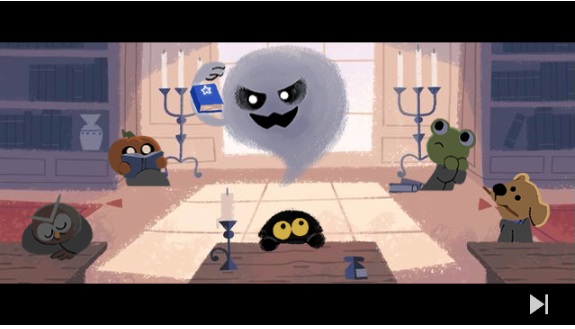
Follow feline freshman Momo on her quest to rescue her  magic academy. Score points and help ward off mischievious ghosts by swiping in the shape of the symbols above the ghosts’ heads. And you’d better pounce fast—the ghost that stole the master spellbook is getting away! 


HAPPY HALLOWEEN DOODLE and BoooOooH ha ha ha to all ghastly ghosts & evil spirits!


Save Momo's Music Academy and earn game points by swiping the shape on top of the ghosts' heads and wipe out all the ghosts.

I scored 1660! 


How many ghosts can you wipe out?


Much more than a just a Google doodle, today many internet surfers enjoyed spooky, interactive, search results instead of Google’s customary and “I’m Feeling Lucky” search options.

Eighteen Halloween's ago, Google posted it's very first Halloween Google Doodle.

Photo right, screen capture of Google's first Halloween Doodle, October 31, 1999.

Internationally, Halloween's first celebration traces back to 1895 in Scotland and for North America the first Halloween was celebrated in 1911.


Enjoy this collage of Halloween Google Doodles above or to experience Google Doodles of Halloween's past, visit the following links:
Halloween 2017 Google Doodle: Jinx's Night Out 
Halloween Momo on Her Mission 2016
Halloween Global Candy Cup 2015
Favorite Monsters Google Doodle 2014
Google Halloween 2013 doodle.
Google Halloween 2012 doodle
Google's 2011 carving pumpkin doodle celebrating 100 Halloween years
Google Halloween 2010 doodle
Google Halloween 2009 doodle
Google Halloween 2008 doodle
Google Halloween 2007 doodle
Google Halloween 2006 doodle
Google Halloween 2005 doodle
Google Halloween 2004 doodle
Google Halloween 2003 doodle
Google Halloween 2002 doodle
Google Halloween 2001 doodle
Google Halloween 2000 doodle
Google Halloween 1999 doodle

Happy Halloween to you and yours!


What do you think of Google’s Halloween doodle today?

ABOUT HALLOWEEN AND HISTORY

Halloween or Hallowe'en (a contraction of "All Hallows' Evening"), also known as All Hallows' Eve, is a yearly celebration observed in a number of countries on October 31, the eve of the Western Christian feast of All Hallows (or All Saints) and the day initiating the triduum of Hallowmas.

Trick-or-treating is a customary celebration for children on Halloween. Children go in costume from house to house, asking for treats such as candy or sometimes money, with the question, "Trick or treat?" The word "trick" refers to "threat" to perform mischief on the homeowners or their property if no treat is given.

According to Frank Leslie's popular monthly, (Volume 40, November 1895, p. 540-543) in Scotland and Ireland, guising – children disguised in costume going from door to door for food or coins – is a traditional Halloween custom, and was recorded in Scotland at Halloween as far back as 1895 where masqueraders in disguise carrying lanterns made out of scooped out turnips, visited homes to be rewarded with cakes, fruit and money.

The practice of Guising at Halloween in North America was first recorded in 1911, where a newspaper in Kingston, Ontario reported children going "guising" around the neighborhood was first noted by Rogers, Nicholas, "Coming Over: Halloween in North America". Halloween: From Pagan Ritual to Party Night. p.76. Oxford University Press, 2002, ISBN 0-19-514691-3.

American historian and author Ruth Edna Kelley of Massachusetts wrote the first book length history of Halloween in the US; The Book of Hallowe'en (1919), and references souling in the chapter "Hallowe'en in America":

"The taste in Hallowe'en festivities now is to study old traditions, and hold a Scotch party, using Burn's poem Hallowe'en as a guide; or to go a-souling as the English used. In short, no custom that was once honored at Hallowe'en is out of fashion now."

OTHER RESOURCES 

▲ Google's Halloween doodle turns you into a witch, CNET, http://news.cnet.com/8301-1023_3-57610125-93/googles-halloween-doodle-turns-you-into-a-witch/
▲ The wizards behind Google's doodles, CNET, http://news.cnet.com/8301-1023_3-57573307-93/the-wizards-behind-googles-doodles/
▲ Halloween witch: The real history behind Google's doodle, The Christian Monitor, http://www.csmonitor.com/Innovation/2013/1031/Halloween-witch-The-real-history-behind-Google-s-doodle 


Please share this on your LinkedIn, Facebook, Twitter, and other social media networks you enjoy! Thanks! This is a reposting from previous Happy Halloween blog postings from AllThingsDigitalMarketing.


This post is an update from prior Halloween blog posts.

Tuesday, March 12, 2019

WWW Reaches Big 030 Today - March 12, 2019

Happy 30th World Wide Web !


"Let the web serve humanity"

~ Tim Berners-Lee, SirTimothy John Berners-Lee (born 8 June 1955), also known as TimBL, is an English engineer and computer scientist, best known as the inventor of the World Wide Web. He is currently a professor of computer science at the University of Oxford and the Massachusetts Institute of Technology (MIT).  @timberners_lee    https://twitter.com/timberners_lee


WWW Inventor, Tim Berners-Lee celebrates on Twitter

Hard to believe WWW is just 30 years, it's done so much and transformed itself so many times one would think it's at least 100.


Oh boy, do I wish it did really serve humanity well. Unfortunately, there's just too much propaganda, bias, control, and greed at the expense of  human rights and democracy. When will this end?


Perhaps it's good intentioned inventor, Tim Berners-Lee can invent an antidote application to counteract this horriffic poison to humanity. If anyone can, I know he can and not just by speaking and advocating but by building something better intended for humanity.

In any event, WWW probably the greatest disruption of the 19th century.

Resources:

  • Latest from Tim Berners-Lee on WWW's 30th: https://webfoundation.org/2019/03/web-birthday-30/
  • https://indianexpress.com/article/technology/tech-news-technology/the-world-wide-web-turns-30-web-inventor-sir-tim-berners-lee-on-the-fight-for-a-better-web-5621800/
  • Sir Tim Berners-Lee on why tech companies cannot forgo human rights for profits,The Indian EXPRESS:  https://webfoundation.org/2019/03/web-birthday-30/
  • The Man Who Invented the WWW Has Mixed Feelings About What The Internet Has Become, Time, http://time.com/5549551/tim-berners-lee-inventor-internet/
  • World Wide Web Consortium, W3C, http://www.w3.org/ - Info on Tim Berners-Lee https://www.w3.org/People/Berners-Lee/#Press
  • Google celebrates with all tech doodle video show


Tuesday, October 30, 2018

Happy 123rd Halloween - October 31, 1895


This post is an update from prior Halloween blog posts.

"Double, double toil and trouble;
fire burn and cauldron bubble."  


~~ William Shakespeare, “Macbeth, 1611 

English poet and playwright, widely regarded as the greatest writer in the English language and the world's pre-eminent dramatist. He is often called England's national poet and the "Bard of Avon". (1564-1616)


2018 Google Doodle celebrates Halloween a day earlier, with theme "The Great Ghoul Duels Catch the flames and when your opponent steals your flames, get them back and earn more points.


2017 Google Doodle celebrates Halloween with the Memo the Cat and her Magic Academy interactive contest doodle.

Follow feline freshman Momo on her quest to rescue her  magic academy. Score points and help ward off mischievious ghosts by swiping in the shape of the symbols above the ghosts’ heads. And you’d better pounce fast—the ghost that stole the master spellbook is getting away! 


HAPPY HALLOWEEN DOODLE and BoooOooH ha ha ha to all ghastly ghosts & evil spirits!


Save Momo's Music Academy and earn game points by swiping the shape on top of the ghosts' heads and wipe out all the ghosts.  

I scored 1660! 


How many ghosts can you wipe out?


Much more than a just a Google doodle, today many internet surfers enjoyed spooky, interactive, search results instead of Google’s customary and “I’m Feeling Lucky” search options.

Eighteen Halloween's ago, Google posted it's very first Halloween Google Doodle.

Photo right, screen capture of Google's first Halloween Doodle, October 31, 1999.

Internationally, Halloween's first celebration traces back to 1895 in Scotland and for North America the first Halloween was celebrated in 1911.


Enjoy this collage of Halloween Google Doodles above or to experience Google Doodles of Halloween's past, visit the following links:
Halloween 2017 Google Doodle: Jinx's Night Out 
Halloween Momo on Her Mission 2016
Halloween Global Candy Cup 2015
Favorite Monsters Google Doodle 2014
Google Halloween 2013 doodle.
Google Halloween 2012 doodle
Google's 2011 carving pumpkin doodle celebrating 100 Halloween years
Google Halloween 2010 doodle
Google Halloween 2009 doodle
Google Halloween 2008 doodle
Google Halloween 2007 doodle
Google Halloween 2006 doodle
Google Halloween 2005 doodle
Google Halloween 2004 doodle
Google Halloween 2003 doodle
Google Halloween 2002 doodle
Google Halloween 2001 doodle
Google Halloween 2000 doodle
Google Halloween 1999 doodle

Happy Halloween to you and yours!


What do you think of Google’s Halloween doodle today?

ABOUT HALLOWEEN AND HISTORY

Halloween or Hallowe'en (a contraction of "All Hallows' Evening"), also known as All Hallows' Eve, is a yearly celebration observed in a number of countries on October 31, the eve of the Western Christian feast of All Hallows (or All Saints) and the day initiating the triduum of Hallowmas.

Trick-or-treating is a customary celebration for children on Halloween. Children go in costume from house to house, asking for treats such as candy or sometimes money, with the question, "Trick or treat?" The word "trick" refers to "threat" to perform mischief on the homeowners or their property if no treat is given.

According to Frank Leslie's popular monthly, (Volume 40, November 1895, p. 540-543) in Scotland and Ireland, guising – children disguised in costume going from door to door for food or coins – is a traditional Halloween custom, and was recorded in Scotland at Halloween as far back as 1895 where masqueraders in disguise carrying lanterns made out of scooped out turnips, visited homes to be rewarded with cakes, fruit and money.

The practice of Guising at Halloween in North America was first recorded in 1911, where a newspaper in Kingston, Ontario reported children going "guising" around the neighborhood was first noted by Rogers, Nicholas, "Coming Over: Halloween in North America". Halloween: From Pagan Ritual to Party Night. p.76. Oxford University Press, 2002, ISBN 0-19-514691-3.

American historian and author Ruth Edna Kelley of Massachusetts wrote the first book length history of Halloween in the US; The Book of Hallowe'en (1919), and references souling in the chapter "Hallowe'en in America":

"The taste in Hallowe'en festivities now is to study old traditions, and hold a Scotch party, using Burn's poem Hallowe'en as a guide; or to go a-souling as the English used. In short, no custom that was once honored at Hallowe'en is out of fashion now."

OTHER RESOURCES 

▲ Google's Halloween doodle turns you into a witch, CNET, http://news.cnet.com/8301-1023_3-57610125-93/googles-halloween-doodle-turns-you-into-a-witch/
▲ The wizards behind Google's doodles, CNET, http://news.cnet.com/8301-1023_3-57573307-93/the-wizards-behind-googles-doodles/
▲ Halloween witch: The real history behind Google's doodle, The Christian Monitor, http://www.csmonitor.com/Innovation/2013/1031/Halloween-witch-The-real-history-behind-Google-s-doodle 


Please share this on your LinkedIn, Facebook, Twitter, and other social media networks you enjoy! Thanks! This is a reposting from previous Happy Halloween blog postings from AllThingsDigitalMarketing.


This post is an update from prior Halloween blog posts.

Tuesday, March 20, 2018

#LoveTwitter - Twitter almost a teen; Reaches the BIG 012 on March 21st: Happy Tweet-Day to you (March 21, 2018) - Twitter thanks everyone for making history!

Happy Tweet Day Twitter! Below are screen captures of tweets taken from Twitter's big 010. Will update with Happy 12th tweet picks soon.

Below is the original article all about Twitter and the Ripple Effect from September 22, 2009. Enjoy and happy tweeting!!

Did you know that the year 2017 marked the year Twitter would become major news and social? Also, the year when message size doubled to 280 characters for all languages (TechCrunch, 11/7/2017) except Japanese, Korean and Chinese languages. As of 216, Twitter had more than 319 million monthly active users (USA Today, 10/26/2017). During our 2016 U.S. presidential election, Twitter became the largest source of breaking news with a record-breaking 40 million election-related tweets sent by 10 p.m. (The New York Times, 11/8/2016).


See Twitter's 10th Birthday video thanking everyone.

TWITTER LOVES EVERYONE! Happy 10th B-Day Twitter #LoveTwitter

Twitter thanks everyone on it's 10th birthday for making history! Twitter has a very thoughtful and symbolic video celebrating 10th birthday.


Still no definitive business model nor any $ profits yet Twitter continues to spread wings, ripple effects and much intrigue!

Why can't politicians be like Twitter?

Wishing TWITTER many more twitterers, tweets and TweetDays!


According to Stan Schroeder, writer of Mashable, Twitter's B-Day is today -- last year I was wrong, I thought it was March 22nd, but it's indeed March 21st -- the first day co-founder Jack Dorsey tweeted his very first tweet.

Here is Schroeder's article from Twitter's 6th (back in 2012), Happy 6th Birthday, Twitter! 


Twitter hasn't changed much with the exception of it's double size character limit, from 140 to 280, and itsphenomenal growth which is currently at 320 million users (February 2016), a usage increase of over 11% vs. last year and +60% increase in the amount of tweets per day.

Last year Twitter recently reported they have 288 million active monthly users and 500 million tweets per day https://about.twitter.com/company.

This year, according to DMR stats, Twitter sees 100 million users log in each day and as of February 10, 2016 there are 320 million people using twitterand 1.3 billion registered Twitter users.

Surprisingly, less than 1/4th are U.S. (23% or 62 million), and over 3/4ths of these users (77% or 209 million) are outside the U.S. According to many resources including Mashable and SocialMedia, Twitter had about 200 million accounts a year ago (2014), and averaged 400M tweets per day. While this statistic may be debatable since others including Mashable indicate that Twitter has over 500 million, Twitter itself has reported that as of February 2013, they have 200 million users. Not surprisingly, 80% of Twitter active users (400 million) are mobile.

Below is the original blog post written back on September 22, 2009 all about Twitter: Everything's the same except for the updated photo and of course the character-limit is now 280.

Twitter, a micro-blog with a 140-character-limit blurb known as a “tweet” having potential to create a chain of social media networking events that can lead to exponentially larger alterations of social media networking instances. Twittering appears to have maximized the power of connecting. In less than 4 years, it is  estimated that there are over 250 million twitter accounts worldwide.

But if you think that Twitter and the bird’s far reaching effect is enough to make your media campaign a success, try spreading your wings and flying. You just might find yourself in a nose-dive!

Of course, everyone is twittering, with hopes of creating shifts in perspectives that will lead to greater connections, better businesses and stronger communities.

It’s been said that a sea gull’s simple flap of a wing can change weather, and so too a simple tweet can create ripple effects in the customers, employees, friends, colleagues and even those people and entities that you have never known and now suddenly have become your followers.

Why then are there still no analytics for measuring effectiveness, or tried and true processes and marketing solutions from this bird?

Although Twitter’s wide massive appeal has grown so quickly in such a brief time, it is still considered new. Twitter became available to the public in 2006 but really gained momentum in April 2007. According to Wikipedia “The tipping point for Twitter's popularity was the 2007 South by Southwest, SXSW, festival. During the event usage went from 20,000 tweets per day to 60,000.” This all occurring after the Web 2.0 buzz of 2006, which arose 2 years after the first Web 2.0 Oreilly Conference, October 5 – 7, 2004, at the Hotel Nikko in San Francisco, CA.

Today, there are many factors that contribute to the success of a social networking marketing campaign and Twitter is just one of the many digital integrated marketing tools. Besides having experience, skill and passion about what you are communicating, successful social media marketing requires a well thought out, detailed, marketing plan and timeline. Even with all this, there are still no guarantees; What works for one company or person  may not be as effective for another.

While there are no magic bullets that will guarantee the overall success of your campaign, below you will find a listing of some helpful tips to guide you through the process of integrating twittering into your corporate digital marketing programs:

1. Create momentum with effective communications and set up kick-off meetings well in advance of your deliverables

2. Optimal participation is key. Schedule regular (weekly or bi-weekly) meetings (virtual or in person) and involve as many employees/departments in your organization.

3. Ensure that your meeting handouts include guidelines for branding specs, e.g., having company logo included on all tweets, regardless of whether a company is using different blog/tweet names for different products,/themes, etc., appropriate tone, buzzwords, keywords, etc.

4. If your social marketing media campaign calls for multiple bloggers and twitterers, make sure your respective tweet names match respective tweet blogs; This information should all be mapped out (e.g., spreadsheet) and incorporated into your digital marketing plan alongside all of the other marketing tools you will be integrating

5. Use common sense and discuss best practice to ensure employee tweeters know their leaps and bounds when contributing to avoid compromising your blogs/tweets integrity and reputation

6. Tie in tweets with your company’s blogs – an example is how Martha Stewart’s tips, ideas, etc., from her blog into tweets – again, not necessarily coming from someone from her company, but created such a brand following that followers as well as employees include her ideas in their blogs

7. Understand and learn of the importance of following potential customers, existing customers, vendors, suppliers, etc.

8. Incorporate short and simple auto-respond tweets for new followers – assuring real-time reply in the event no one is able to respond immediately; Although the majority of folks recommend not using auto-responds, my suggestion is to test the waters but keep auto-responds short, thanking them for connecting and sharing relevant information.  If you feel auto-responding is working against you, simply remove it. At least you can say you gave it a try.

9. Understand the importance of hashtags and other application enhancements and use them carefully. E.g., including hashtags in your tweets, e.g., #followfriday; and applications, Tweet Meme, etc. There are pros and cons to hashtags - some folks feel the short 140-character blurbs get distorted from the #hashtag symbol while others are embracing it. So far, I haven't been incorporating hashtags into my tweets. I plan on giving #hashtags a try soon.

10. If you are interested in following please feel free to follow me on Twitter at www.twitter.com/gbdaly

"Twitter reaches the BIG ### today! Happy Tweet-Day to you!" is part of the "evergreen marketing insighter" series by Gloria Buono-Daly This blog is updated every year on Twitter's birthday and was originally written by Gloria Buono Daly (c) 2009.

Tuesday, October 31, 2017

Happy 122nd Halloween - October 31, 1895


"Double, double toil and trouble;
fire burn and cauldron bubble."  


~~ William Shakespeare, “Macbeth, 1611 

English poet and playwright, widely regarded as the greatest writer in the English language and the world's pre-eminent dramatist. He is often called England's national poet and the "Bard of Avon". (1564-1616)


Google Doodle celebrates Halloween with the Memo the Cat and her Magic Academy interactive contest doodle.

Follow feline freshman Momo on her quest to rescue her  magic academy. Score points and help ward off mischievious ghosts by swiping in the shape of the symbols above the ghosts’ heads. And you’d better pounce fast—the ghost that stole the master spellbook is getting away! 


HAPPY HALLOWEEN DOODLE and BoooOooH ha ha ha to all ghastly ghosts & evil spirits!


Save Momo's Music Academy and earn game points by swiping the shape on top of the ghosts' heads and wipe out all the ghosts.  

I scored 1660! 


How many ghosts can you wipe out?


Much more than a just a Google doodle, today many internet surfers enjoyed spooky, interactive, search results instead of Google’s customary and “I’m Feeling Lucky” search options.

Eighteen Halloween's ago, Google posted it's very first Halloween Google Doodle.

Photo right, screen capture of Google's first Halloween Doodle, October 31, 1999.

Internationally, Halloween's first celebration traces back to 1895 in Scotland and for North America the first Halloween was celebrated in 1911.


Enjoy this collage of Halloween Google Doodles above or to experience Google Doodles of Halloween's past, visit the following links:

Halloween Momo on Her Mission 2016
Halloween Global Candy Cup 2015
Favorite Monsters Google Doodle 2014
Google Halloween 2013 doodle.
Google Halloween 2012 doodle
Google's 2011 carving pumpkin doodle celebrating 100 Halloween years
Google Halloween 2010 doodle
Google Halloween 2009 doodle
Google Halloween 2008 doodle
Google Halloween 2007 doodle
Google Halloween 2006 doodle
Google Halloween 2005 doodle
Google Halloween 2004 doodle
Google Halloween 2003 doodle
Google Halloween 2002 doodle
Google Halloween 2001 doodle
Google Halloween 2000 doodle
Google Halloween 1999 doodle

Happy Halloween to you and yours!


What do you think of Google’s Halloween doodle today?

ABOUT HALLOWEEN AND HISTORY

Halloween or Hallowe'en (a contraction of "All Hallows' Evening"), also known as All Hallows' Eve, is a yearly celebration observed in a number of countries on October 31, the eve of the Western Christian feast of All Hallows (or All Saints) and the day initiating the triduum of Hallowmas.

Trick-or-treating is a customary celebration for children on Halloween. Children go in costume from house to house, asking for treats such as candy or sometimes money, with the question, "Trick or treat?" The word "trick" refers to "threat" to perform mischief on the homeowners or their property if no treat is given.

According to Frank Leslie's popular monthly, (Volume 40, November 1895, p. 540-543) in Scotland and Ireland, guising – children disguised in costume going from door to door for food or coins – is a traditional Halloween custom, and was recorded in Scotland at Halloween as far back as 1895 where masqueraders in disguise carrying lanterns made out of scooped out turnips, visited homes to be rewarded with cakes, fruit and money.

The practice of Guising at Halloween in North America was first recorded in 1911, where a newspaper in Kingston, Ontario reported children going "guising" around the neighborhood was first noted by Rogers, Nicholas, "Coming Over: Halloween in North America". Halloween: From Pagan Ritual to Party Night. p.76. Oxford University Press, 2002, ISBN 0-19-514691-3.

American historian and author Ruth Edna Kelley of Massachusetts wrote the first book length history of Halloween in the US; The Book of Hallowe'en (1919), and references souling in the chapter "Hallowe'en in America":

"The taste in Hallowe'en festivities now is to study old traditions, and hold a Scotch party, using Burn's poem Hallowe'en as a guide; or to go a-souling as the English used. In short, no custom that was once honored at Hallowe'en is out of fashion now."

OTHER RESOURCES 

▲ Google's Halloween doodle turns you into a witch, CNET, http://news.cnet.com/8301-1023_3-57610125-93/googles-halloween-doodle-turns-you-into-a-witch/
▲ The wizards behind Google's doodles, CNET, http://news.cnet.com/8301-1023_3-57573307-93/the-wizards-behind-googles-doodles/
▲ Halloween witch: The real history behind Google's doodle, The Christian Monitor, http://www.csmonitor.com/Innovation/2013/1031/Halloween-witch-The-real-history-behind-Google-s-doodle 


Please share this on your LinkedIn, Facebook, Twitter, and other social media networks you enjoy! Thanks! This is a reposting from previous Happy Halloween blog postings from AllThingsDigitalMarketing.

Wednesday, October 18, 2017

Happy 166th to Herman Melville's classic Moby Dick - October 18, 1851


“There she blows!-there she blows! A hump like a snow-hill! It is Moby Dick!” 
~~ Herman Melville, American author, quote taken from his book, Moby Dick, chapter 133: The Chase -- First Day (b. August 1, 1819 – d. September 28, 1891)


Hard to believe, Herman Melville’s classic, "Moby Dick," was not well received in 1851 by British reviewers and bombed big time. Who would think that it was a native New Yorker author, Herman Melville, who would coin "There she blows ~ There she blows ..."  Image above screenshot taken from Google doodle, celebrating Moby Dick's 161st as posted on October 18, 2012 at Google.com.

Classified as American Romanticism, in Britain it was first published by Richard Bentley in London on October 18, 1851 and on November 14, 1851 in the U.S.

"Moby Dick" sold only 500 copies in the United Kingdom, compared to 6,700 for Melville's first book, "Typee."

According to The Christian Science Monitor“shortly after Melville's death in 1891, his publisher reprinted several of his novels, including "Moby Dick."

These new editions excited New York's literary scene. Like long-smoldering embers, this underground movement kept Melville's name alive.

Eventually, the flame spread. So much discussion surrounded "Moby Dick" that many people gave the book a second chance.”


Other Resources 
 The Christian Science Monitor, Herman Melville books: At first, 'Moby Dick' was a total flop
Moby Dick on Wikipedia https://en.wikipedia.org/wiki/Moby-Dick

Please share this on your LinkedIn, Facebook, Twitter, and other social media networks you enjoy! Thanks! This article is a reposting from earlier Moby Dick blog postings from AllThingsDigitalMarketing.

Monday, October 31, 2016

Happy 105th Halloween - October 31, 1895


"Double, double toil and trouble;
fire burn and cauldron bubble."  


~~ William Shakespeare, “Macbeth, 1611 

English poet and playwright, widely regarded as the greatest writer in the English language and the world's pre-eminent dramatist. He is often called England's national poet and the "Bard of Avon". (1564-1616)


Google Doodle celebrates Halloween with the Memo the Cat and her Magic Academy interactive contest doodle.

Follow feline freshman Momo on her quest to rescue her  magic academy. Score points and help ward off mischievious ghosts by swiping in the shape of the symbols above the ghosts’ heads. And you’d better pounce fast—the ghost that stole the master spellbook is getting away! 


HAPPY HALLOWEEN DOODLE and BoooOooH ha ha ha to all ghastly ghosts & evil spirits!


Save Momo's Music Academy and earn game points by swiping the shape on top of the ghosts' heads and wipe out all the ghosts.  

I scored 1660! 


How many ghosts can you wipe out?


Much more than a just a Google doodle, today many internet surfers enjoyed spooky, interactive, search results instead of Google’s customary and “I’m Feeling Lucky” search options.

Eighteen Halloween's ago, Google posted it's very first Halloween Google Doodle.

Photo right, screen capture of Google's first Halloween Doodle, October 31, 1999.

Internationally, Halloween's first celebration traces back to 1895 in Scotland and for North America the first Halloween was celebrated in 1911.


Enjoy this collage of Halloween Google Doodles above or to experience Google Doodles of Halloween's past, visit the following links:

Halloween Momo on Her Mission 2016
Halloween Global Candy Cup 2015
Favorite Monsters Google Doodle 2014
Google Halloween 2013 doodle.
Google Halloween 2012 doodle
Google's 2011 carving pumpkin doodle celebrating 100 Halloween years
Google Halloween 2010 doodle
Google Halloween 2009 doodle
Google Halloween 2008 doodle
Google Halloween 2007 doodle
Google Halloween 2006 doodle
Google Halloween 2005 doodle
Google Halloween 2004 doodle
Google Halloween 2003 doodle
Google Halloween 2002 doodle
Google Halloween 2001 doodle
Google Halloween 2000 doodle
Google Halloween 1999 doodle

Happy Halloween to you and yours!


What do you think of Google’s Halloween doodle today?

ABOUT HALLOWEEN AND HISTORY

Halloween or Hallowe'en (a contraction of "All Hallows' Evening"), also known as All Hallows' Eve, is a yearly celebration observed in a number of countries on October 31, the eve of the Western Christian feast of All Hallows (or All Saints) and the day initiating the triduum of Hallowmas.

Trick-or-treating is a customary celebration for children on Halloween. Children go in costume from house to house, asking for treats such as candy or sometimes money, with the question, "Trick or treat?" The word "trick" refers to "threat" to perform mischief on the homeowners or their property if no treat is given.

According to Frank Leslie's popular monthly, (Volume 40, November 1895, p. 540-543) in Scotland and Ireland, guising – children disguised in costume going from door to door for food or coins – is a traditional Halloween custom, and was recorded in Scotland at Halloween as far back as 1895 where masqueraders in disguise carrying lanterns made out of scooped out turnips, visited homes to be rewarded with cakes, fruit and money.

The practice of Guising at Halloween in North America was first recorded in 1911, where a newspaper in Kingston, Ontario reported children going "guising" around the neighborhood was first noted by Rogers, Nicholas, "Coming Over: Halloween in North America". Halloween: From Pagan Ritual to Party Night. p.76. Oxford University Press, 2002, ISBN 0-19-514691-3.

American historian and author Ruth Edna Kelley of Massachusetts wrote the first book length history of Halloween in the US; The Book of Hallowe'en (1919), and references souling in the chapter "Hallowe'en in America":

"The taste in Hallowe'en festivities now is to study old traditions, and hold a Scotch party, using Burn's poem Hallowe'en as a guide; or to go a-souling as the English used. In short, no custom that was once honored at Hallowe'en is out of fashion now."

OTHER RESOURCES 

▲ Google's Halloween doodle turns you into a witch, CNET, http://news.cnet.com/8301-1023_3-57610125-93/googles-halloween-doodle-turns-you-into-a-witch/
▲ The wizards behind Google's doodles, CNET, http://news.cnet.com/8301-1023_3-57573307-93/the-wizards-behind-googles-doodles/
▲ Halloween witch: The real history behind Google's doodle, The Christian Monitor, http://www.csmonitor.com/Innovation/2013/1031/Halloween-witch-The-real-history-behind-Google-s-doodle 
Please share this on your LinkedIn, Facebook, Twitter, and other social media networks you enjoy! Thanks!